Driven by Intent: How Swansea City Outsmarts Football’s Shrinking Gym Window
Hannah Knowles, Catapult Sports
- Bridging the pitch and the gym: Swansea City integrated Catapult Vector 8 on the pitch with Perch velocity-based training (VBT) in the gym, giving staff a single, connected platform to manage fatigue and prescribe precise training loads across a congested Championship schedule.
Key Takeaways:
- Returning time to Academy coaches: Automated tracking eliminates manual database entry, allowing one coach to manage groups of up to 30 Academy players across multiple training sites without sacrificing individual precision.
- Driving competitive intent and safety: Real-time leaderboards in the gym and sprint tracking on the grass turn sessions into competitive drivers, ensuring athletes reach required physical thresholds to support performance and injury risk reduction.
How Swansea City uses Catapult and Perch to develop players at every age group and every site
Swansea City’s first team trains without a day off. Four days to prepare for each match, a Championship schedule that rarely relents, and a gym window that shrinks every season.
“Every week is a game or two on repeat,” says Head of Performance Patrick Orme. “We all know how important the gym is, and a busy schedule doesn’t change that. But we have to get more creative in how we prescribe work.”
Swansea City has always developed its own. Nine seasons into life in the Championship, with head coach Vítor Matos pushing for a return to the Premier League, the route to the first team still runs through the Academy. That pathway has to hold up inside a schedule like this one. It’s why Swansea runs Catapult across the men’s first team, the women’s first team, the U21s and the U18s. This summer, as the club rolled out Vector 8, it added Perch to the same contract. Perch now powers in-gym programming and load management through velocity-based training (VBT) at every one of Swansea’s training sites.
Orme has worked with Catapult since his time at Liverpool and Bristol City, and has watched Perch become part of how the club programmes and develops players. “The feedback from the Academy staff has been really strong,” he says, “particularly around how much it’s helped their workflow.”

Football’s shrinking gym window
The cost of a congested calendar is well documented. Tracking a UEFA Champions League squad across two seasons, researchers found that players’ physical output held up when they played twice a week, but their injury rate rose more than sixfold, from 4.1 to 25.6 injuries per 1,000 hours of exposure.[1] Three to four days between matches was enough to protect performance, not enough to protect the player.
Swansea feel that squeeze every week. Staff work to a four-day lead-in before each match, building robustness in the gym without leaving players flat for the next day’s football session.
The Academy faces its own version of the same problem. Coaches manage large groups, record every session under the Elite Player Performance Plan (EPPP) and deliver across several training sites. Until recently, the club tied certain equipment to certain sites.
Swansea needed a VBT solution that made every gym session count, scaled to big groups, and followed players wherever they trained.
Why Perch
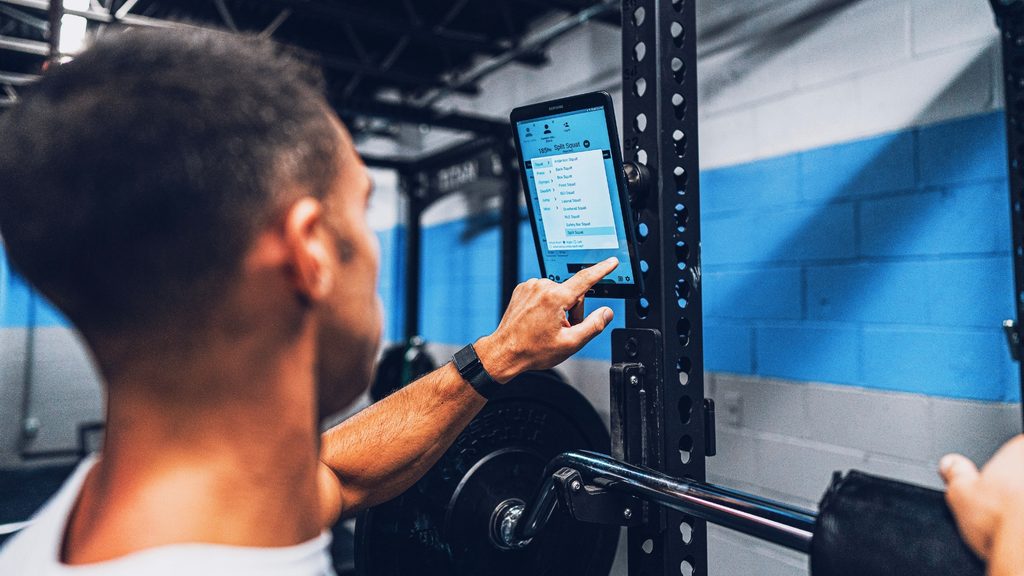
Velocity-based training is how Swansea makes the few gym opportunities it gets count. By measuring bar speed, staff judge performance and fatigue on objective output rather than on set-and-rep schemes that may not match what a player can give that day.
The research is clear on why that matters. In one eight-week squat study, lifters who stopped each set after losing 20% of their bar velocity made similar strength gains to those who pushed on to a 40% loss, and improved their countermovement jump almost three times as much (9.5% versus 3.5%). The first group did all of that while performing 40% fewer repetitions.[2] Measuring velocity, and the intent behind it, is what lets a coach deliver the right stimulus for the adaptation they want.
Swansea’s performance team already knew what visible bar speed can do for lifting, and for conversations. “If we’re on a strength day and your bar speed is at 0.8, you’re probably not getting stronger,” says Orme. “You need to put more weight on the bar.”
The team also knew where older systems fell short. “They’re great in the moment,” Orme explains. “What they’re not so great at is the software behind them, and how you use the data you collect. Programming can be a bit fiddly.”
Perch answered both needs, and it came from a company the club already trusted. “When you’re trying to bring in something completely new, it can be a challenge,” says Orme. “If we’re going with one contract, from a company we already have a strong working relationship with, then that can only be a positive. You’ve got a very reliable name in Catapult. You trust the system, you trust the people.”
Buying Catapult and Perch together also delivered on the club target of working efficiently. “The pricing point helps a lot,” says Orme. Value, though, is what decided it. “The fact that Perch can be used across big squads, different squads, a number of players and levels makes it a lot more valuable. The software goes across an entire programme.”
Staff find Perch easy and intuitive, especially for programming. “I can put a session in, then I still have the ability to spend time around the gym, speaking to people,” says Orme. “There are a million ways to apply GPS or VBT. But bringing it together into an interface that’s actually usable, to programme properly and record properly, that’s huge. Perch is far more advanced than the competitors.”
The Academy, where Perch makes the biggest impact
Swansea’s Academy has felt Perch’s impact most. Since the first trial, the club has extended its Catapult contract to two more age groups and brought in more Perch cameras.
One coach, a whole group
First-team staff have the numbers to watch every rep. Academy staff don’t. “You’ve got maybe one or two members of staff to a group of anywhere between 15 and 30 players,” says Orme.
Perch closes that gap. “They can go to a player, give them their programme, and bang, off they go,” he says. “They know they’re getting that feedback from Perch, without needing to watch every single activity. The player knows exactly what they need to be doing. The staff member can see what they’ve done and what it looked like without being there in that moment. They can manage a much bigger group.”
Swansea recently renovated its Academy gym to create a larger working area. With Perch, coaches now see intent across the whole room.
Coaching, not databases
Under EPPP, Swansea’s Academy records everything each player does, and every session feeds that player’s long-term development record. Orme says Catapult and Perch cut the time practitioners spend entering that data, and give it back to them as coaching time.
“No one becomes a physical performance coach, a sports scientist or an S&C coach because they want to fill in databases,” he says. “They want to work with players, be hands-on, deliver sessions and coach people. The more that technology can handle the other side, the better. They’re really, really happy with that.”
One pathway, every site
Perch now follows Swansea’s players wherever they train. “In the past, we’ve only had certain equipment at certain sites,” says Orme. “Now we can cover all the different sites and use it across different age groups. It’s nice for continuity.”
That continuity builds the pathway. Younger age groups focus heavily on development, and Swansea now tracks each player’s physical progress the whole way through, from their first Academy session to the edge of the first team.
Competition drives intent
For professional footballers, anything that sharpens the competitive atmosphere sharpens performance. “The competitive bit is massive,” says Orme. “They’re players, they’re athletes, they’re footballers, but mostly they’re competitors. One of the biggest tools we have as practitioners is using competition to drive intent, to drive quality, to drive pretty much everything we do.”
During the season, the first team’s schedule keeps much of its gym work isometric. When staff do run speed sessions, Perch takes centre stage. Players move the bar as fast as they can, and the results go straight up on the screen.
The leaderboard brings out every personality in the squad. The quiet ones get their heads down and post big numbers. Others make sure everyone hears about it. Orme points to one naturally gifted athlete who rarely chooses the gym. “When he gets to the top of the leaderboard, he’s probably one of the loudest ones bouncing about,” he says. “He’s a big character. It brings everyone together and brings everyone along for the ride.”
“The atmosphere is incredible,” Orme adds. “The way it changes people.”
Gym to the pitch
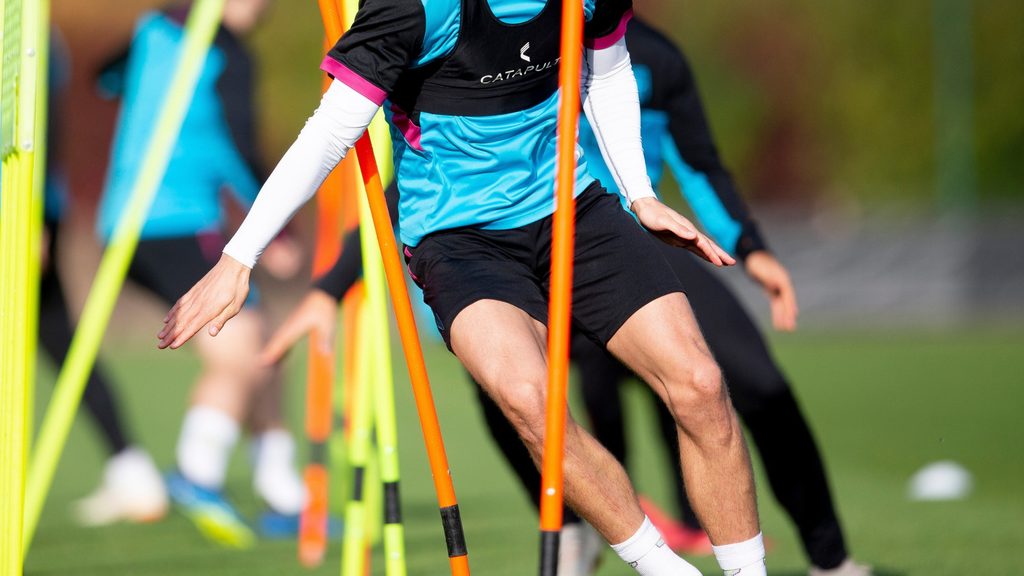
Swansea carries the same principle onto the grass. The club regularly runs max-speed exposures with players wearing Catapult vests. Players understand these sessions help protect them from hamstring injuries, and “using Catapult helps drive the right intent,” says Orme.
Even so, they can’t resist the numbers. “As soon as the lads finish the runway, they’re going straight over to the iPad to see what speed they’ve hit,” he says.
The data confirms the effort. After a recent session of eight maximal accelerations over 15 metres, Orme checked the GPS report. Of 25 players training, all but two hit the top acceleration band. “You look and you go, ‘I’ve got exactly what I wanted from that,’” he says. “That’s the benefit of tools like this. You know you’re getting what you need from each session and each player.”
Swansea reports GPS data to the head coach every day. That shared view helps staff and coaches balance the risks and benefits of different work at different points in the week.
Trust under pressure
For Swansea, reliability isn’t a nice-to-have, and Orme learned why the hard way.
Around a decade ago, at a different club and using a different GPS provider, Orme’s team started pushing the boundaries with live data. They wanted to feed information from the pitch straight into decision-making during sessions. The competitor’s system couldn’t hold up. “It was with the best intention, because we wanted to be innovative,” he recalls. “Then a laptop would crash, and you would not be able to deliver what was wanted due to something beyond my control.”
That experience shaped everything that followed. “We got to a point where we said ‘there’s got to be a better way,’” says Orme. “That’s where my love of Catapult came from, going to a system where you have that reliability. I’d never go back.”
The stakes in elite football make that trust essential. “There’s a lot of pressure in this industry,” he says. “Some of the decisions you make can hang on whether we are successful or not. That sounds extreme, but that’s where trust becomes a massive thing.”
Catapult’s support backs that trust up. Orme regularly messages his Catapult contact with questions, most recently a screenshot of acceleration bands to check his reading. “There are fewer issues, and when there are, they get sorted pretty much instantly,” he says. “Most people work normal hours, but in sport we don’t. Catapult works with us. That support is invaluable.”
Building the next generation
Swansea City built its history on players who came through the ranks, a tradition stretching back to the 1950s. Today, Catapult and Perch give the club one connected view of that journey. GPS measures the work on the pitch, Perch programmes and measures the work in the gym, across every squad and every site.
“Practitioners want to quantify what they’re doing with data that’s valid and reliable,” says Orme. “Then you need a system that brings it all together so you can actually use it.”
The next generation of Swansea players now carries its development record with it, from the first session in the Academy gym to the first-team debut.
Sources
1. Dupont G, Nedelec M, McCall A, et al. Effect of 2 soccer matches in a week on physical performance and injury rate. American Journal of Sports Medicine, 2010;38(9):1752-8.
2. Pareja-Blanco F, Rodríguez-Rosell D, Sánchez-Medina L, et al. Effects of velocity loss during resistance training on athletic performance, strength gains and muscle adaptations. Scandinavian Journal of Medicine & Science in Sports, 2017;27(7):724-735.
Q&A
With matches every three to four days, standard gym windows shrink quickly. Swansea City paired Catapult Vector 8 on the pitch with Perch in the weight room across the senior and Academy squads. This integrated platform gives performance staff the precision to monitor output, manage fatigue, and make informed decisions on daily physical volume without burning players out.
Traditional set-and-rep schemes do not account for how an athlete feels on any given day. By tracking bar speed in real time, coaches assess intent and fatigue on objective output rather than assumptions. This allows staff to adjust weight dynamically, encourage competition in the gym, and deliver the exact physiological stimulus needed to train smarter.
With one or two staff members responsible for 15 to 30 players across different training sites, manual logging used to drain coaching hours. Perch tracks each lift automatically in the background, feeding individual development records without paperwork. This removes administrative friction and keeps coaches where they matter most: on the floor coaching athletes.