Testing times: the technology behind Australia’s biggest Test year
Dean McNamara and Ross Herridge, Cricket Australia Physical Performance.
Key Takeaways:
- Unprecedented Schedule: The Australian men’s Test team faces the massive challenge of playing up to 21 Test matches in a 13-month period between August 2026 and August 2027. This intense schedule condenses what is historically a two-year workload into just over a single year
- Massive Fast Bowling Workload: The fast bowling cohort is forecasted to deliver over 16,000 balls across the upcoming calendar. To manage this extreme physical demand, the team will need to rely on their domestic fast bowling depth and utilize all-rounders for meaningful bowling shifts rather than just token overs.
- Data-Driven Management: The coaching and support staff rely heavily on sports science technology, such as Catapult wearables and the TeamWorks athlete management system, to monitor physical attrition. This technology tracks metrics like run-up velocity and instantaneous player load, allowing the staff to make informed, real-time decisions regarding athlete training, rotation, and selection.
Twenty Test matches. A goal of taking four hundred wickets. Numbers you’d expect across a 24-month period. The difference this time: it’s happening in 13 months.
That is the challenge in front of the Australian men’s Test team from August 2026 to August 2027: twenty Tests, with a twenty-first if we qualify for the World Test Championship Final. All in the space of just over a year. The equivalent would be an AFL Grand Final being played, and the next season starting the following week.
This is going to be a resource and attrition challenge, particularly for the fast bowling cohort. Taking it on, the coaches, support staff, and players have a number of options to help support, guide, and react to the hurdles that come up as the year progresses. We have an astute, forward-thinking coaching staff, highly qualified support staff, and the data science and analytics department to help underpin all of it.
The first step in addressing the challenge is knowing what we are really preparing for. The most obvious and demanding component is how we manage and guide our fast bowling cohort through what will be, from a competition load perspective, the most laborious 12 months of Test cricket most of them will have faced in their careers.
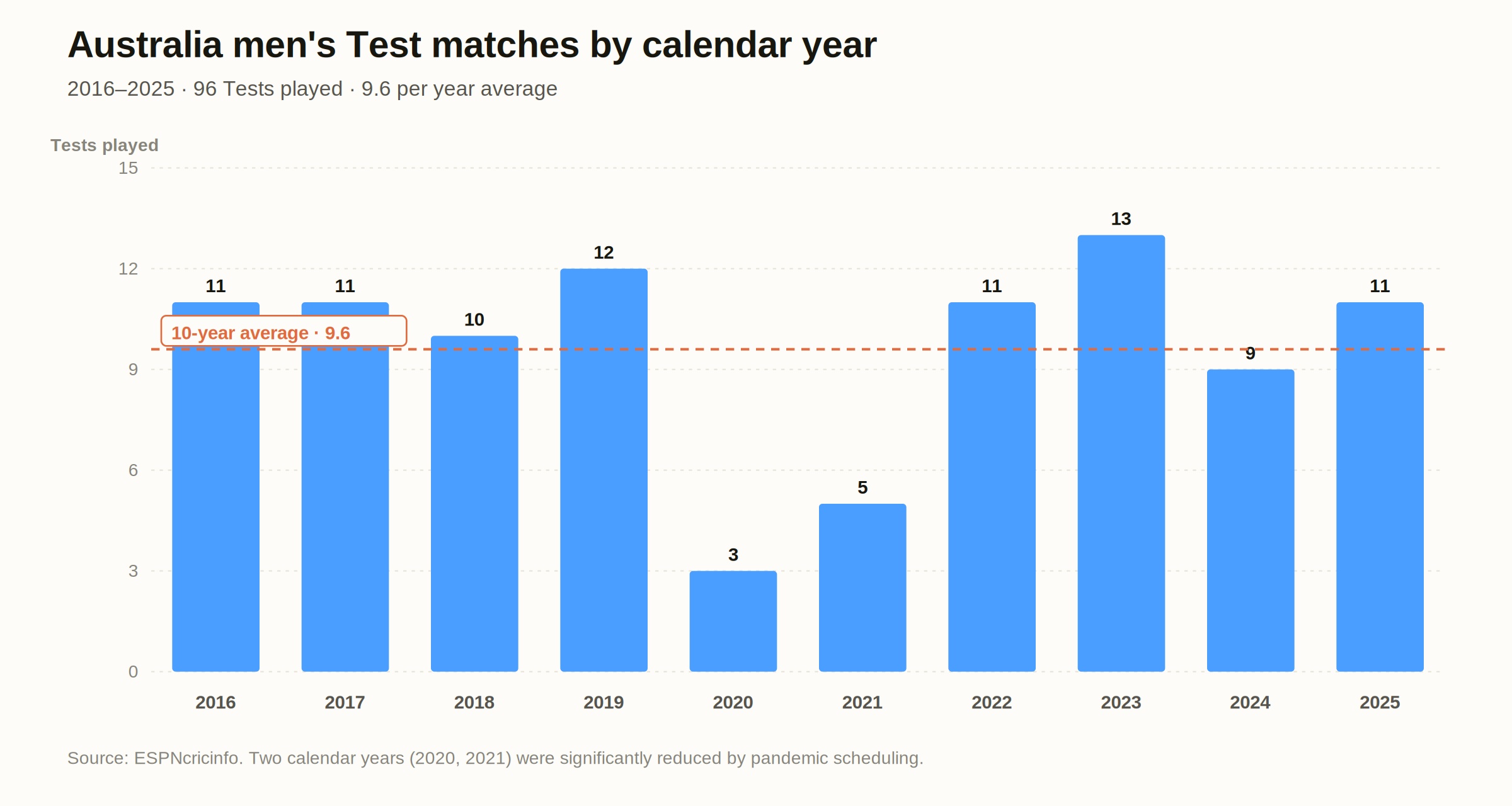
Across the past ten calendar years, Australia has played 96 Tests, averaging 9.6 per year.
Forecasting the workload
It begins with forecasting the likely workloads our fast bowlers will be asked to get through. Match history from venue to venue, combined with coach nuance and guidance, has led us to project an estimate of what we think the fast bowling load will look like across the year.
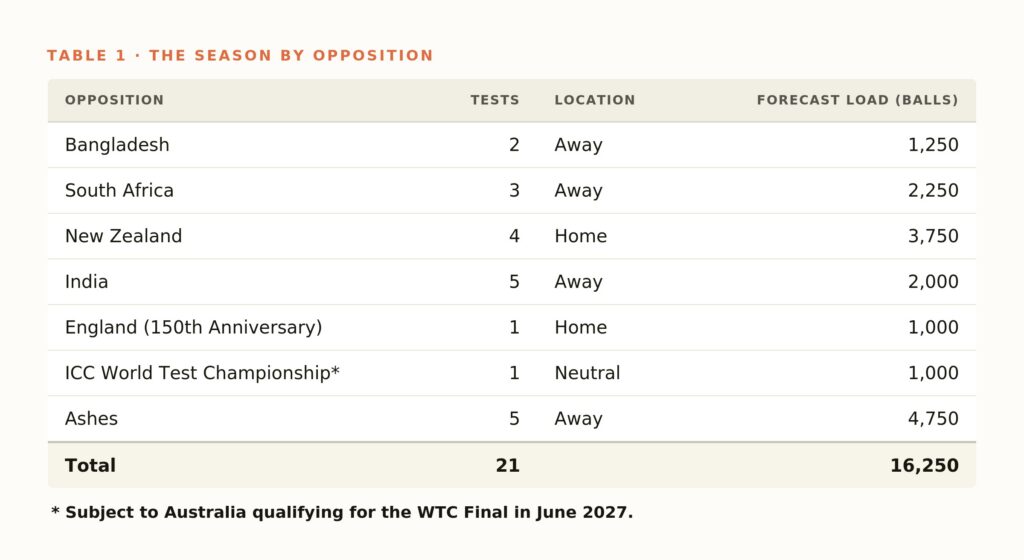
The journey starts with two Tests in Australia’s top end against Bangladesh, followed shortly after by three Tests in South Africa against the current World Test Championship holders. We return to the Australian summer with four Tests against a strong New Zealand side, and then immediately head away for five Tests in India. From there we return home for a pink-ball, one-off Test against England at the MCG – the 150th Anniversary Test – then the World Test Championship Final at The Oval. This all builds toward an away Ashes campaign: five Tests in England.
Bowling volume is only part of the picture. Every Test also carries an underpinning running load: metres covered in the field, high-speed metres, sprints, accelerations and decelerations, all of it captured by Catapult. Data from three of our elite fast bowlers across their Test careers shows how far that load can range from a typical match to a peak one.
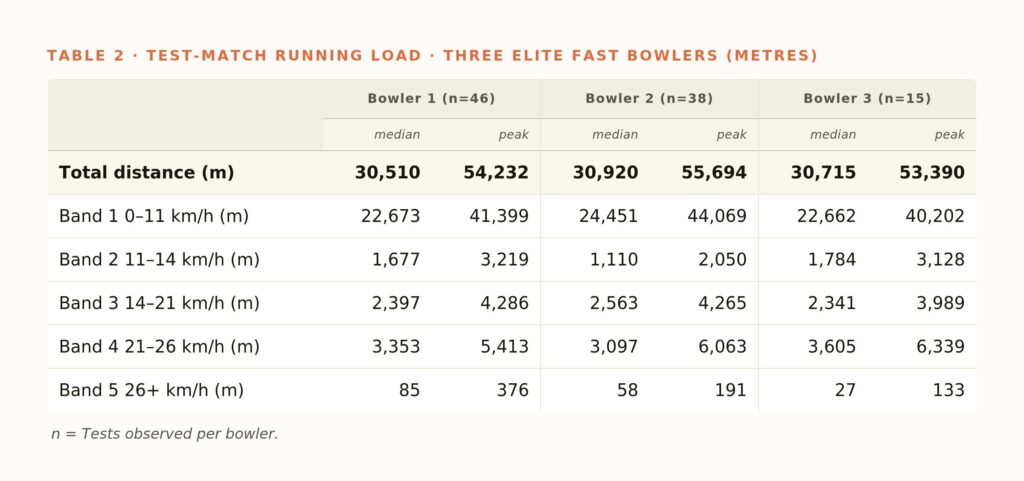
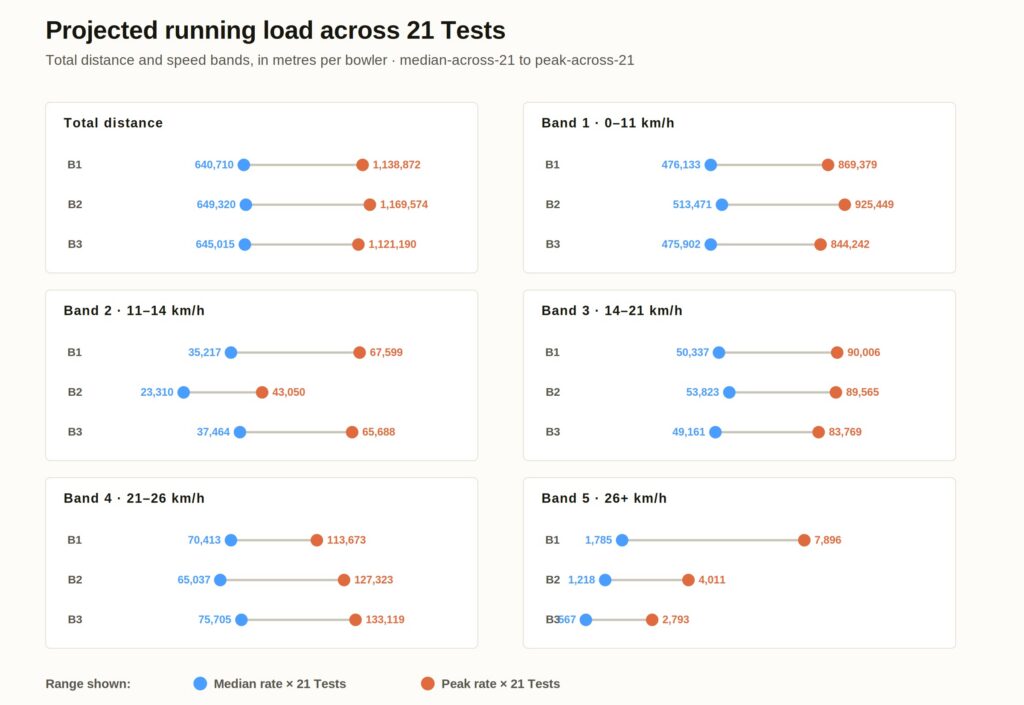
Accumulated running loads across 20-21 Tests will extend into the hundreds of thousands of metres. Tailoring running programs for non-selected players and managing between-match loads for those that do play are vital in making sure the fast bowler is ready to perform.
The compression in competition is real, and it’s worth putting into perspective.
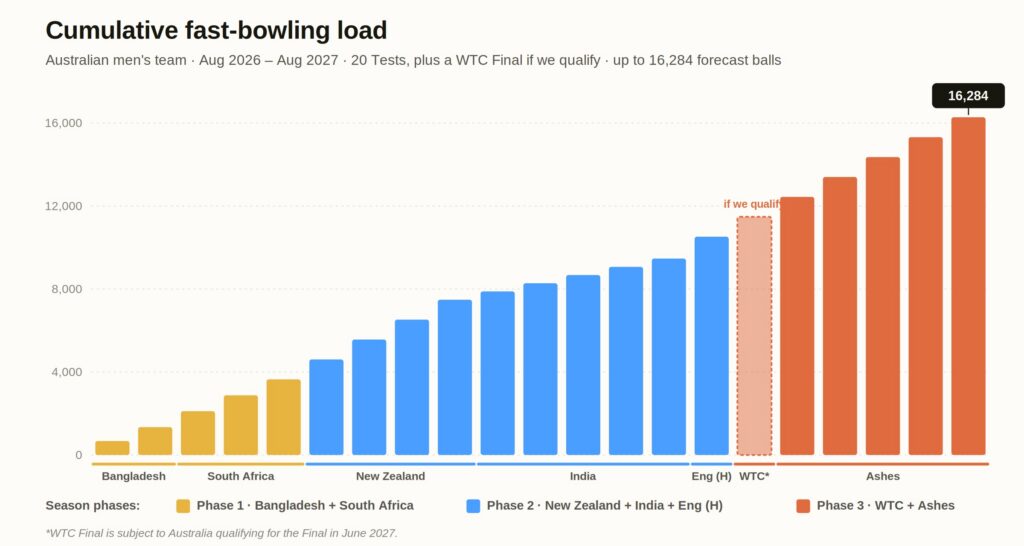
Just over 16,000 balls of fast bowling load, across a 20-21 Test schedule, across 13 months. That’s the sort of total that historically would have been distributed across two years of Test cricket.
And the honest answer is no group of Australian fast bowlers has ever done this before. It’s genuinely new territory. Twenty Tests, four hundred wickets, the World Test Championship, and the Ashes. The expectation remains winning, not just getting through.
That’s a big statement. But it cannot just be a leap of faith. It’s the product of a lot of work at the intersection of coaching, sport science, and technology.
Where the technology fits
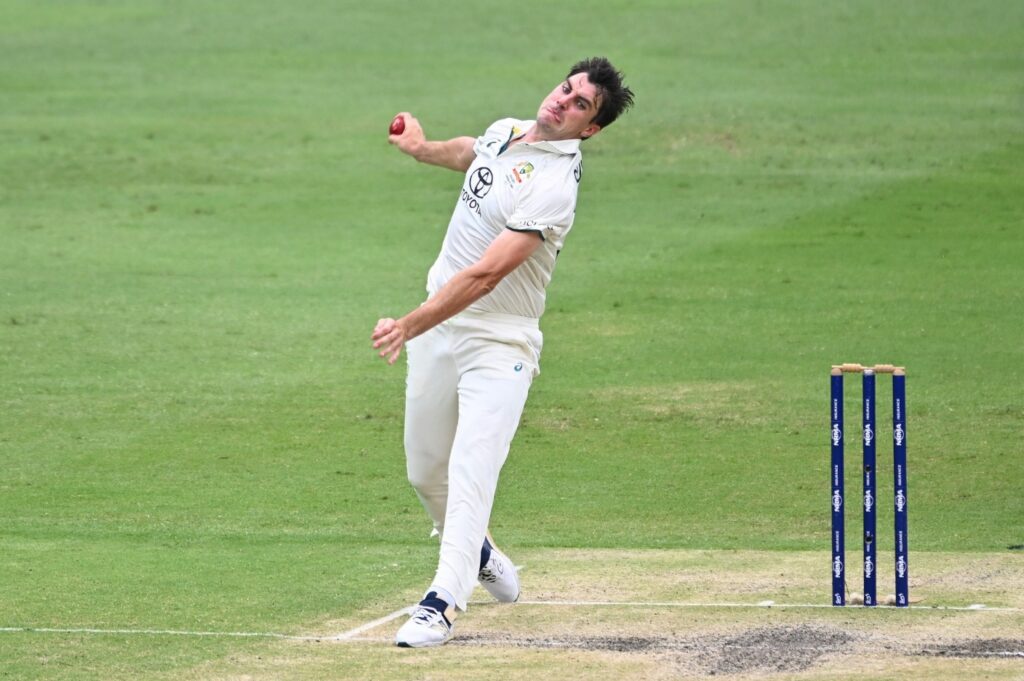
Cricket is an event-based sport. Everything happens after the ball is bowled. The batter reacts to the delivery, the fielders react to the batter, and every downstream event (the catch, the run-out, the misfield, the wicket) traces back to the same first act: the bowler bowling the ball.
That’s why the technology behind fast bowling load starts with detecting the ball itself.
Catapult has been one of Australian cricket’s sport science technology partners for more than a decade. Their wearable units are not just GPS trackers. Inside each are gyroscopes, magnetometers, and accelerometers, each measuring different things. Collectively, they let us determine events. In this case, that a ball has been bowled.
Autonomous ball detection is a real step forward in itself. Gone are the days of relying on athletes to count and self-report how many balls they bowled at training. The device does it, automatically and objectively, which has a major impact on training practice.
Once the delivery is detected, we can attach intensity metrics to it. Run-up distance. Run-up velocity: mean, max, and the velocity at the moment of delivery. Instantaneous player load values. All of this, along with gyroscope-driven measures of roll, yaw, and pitch, helps us build an individual pattern of bowling for our athletes over time.
Bowlers have to adhere to the strict laws of what a legal delivery is. But within those laws, every bowler has their own subtle yet unique way of bowling: their bowling fingerprint. That fingerprint means fast bowling intensity has to be looked at on an individual basis. Relative intensity scores (how a bowler’s session compares against their own baseline) give us far richer information than absolute numbers. Comparing a training session against a meaningful match lets us categorise the intensity of what each bowler is actually doing on any given day.
All of that runs through the Catapult system, and it’s the first step in monitoring our fast bowlers.
The conversation builds the plan
All of this still requires a group of coaches and support staff to stitch the data together, build context, add a human element, and ultimately apply it. The athlete, most importantly, completes the loop.
When a bowling coach and support staff sit down to plan out for an individual fast bowler, we are bringing all of this data together, adding personal circumstance, match and strategy demands, and collectively putting together a schedule for that bowler. But as the saying goes, everyone has a plan until you get punched in the face — we have no doubt we are going to get punched in the face. High level coaching, sharp management, and our ability to lean on sports science practices are going to put us in the best position to react and stay agile.
The selection conversation is the same. With twenty Tests to cover, it’s likely no group of six or seven quicks bowls all of them. Team make up and fast bowling depth are key considerations. The plan needs depth, and it needs to spread load intelligently. All-rounders taking on meaningful bowling shifts (not token overs) are one of the levers the plan pulls on when managing key fast bowlers. A strong Australian domestic competition and a selection pool of high quality fast bowlers is vital. Across Australian Cricket, Performance Services has been structured with player movement, communication, and collaboration in mind. That structure gives us access to fast bowling depth, and other positions, right across the Australian Cricket system.
If we take our historical competition fast bowling deliveries as the upper limit of what a fast bowler might be able to complete, we expect that ceiling to be reached somewhere through the India Test series. From there we still have to navigate the Test at the MCG, a WTC Final, and the Ashes. We are going to have to find a way to fit the square peg through the round hole.
Match-to-match loading in Test cricket carries high variability. How we react and prepare for the next match matters. The data tells us when we’re on track and when we’re not, whether a player is coping with the demands, and it lets us pivot in real time. It’s an unbiased, unemotional input into a conversation between the athlete, coach, and support staff.
Decisions are still made by the people in the room: players, coaches, support staff, analytics team, and management. And in cricket, a sprinkle of luck never hurts.
A different sort of year
The next thirteen months will ask more of Australia’s fast bowlers than any similar period the sport has seen. It will ask more of the people around them, too.
Match management, team selections, world-class cricketers, and forward-thinking coaching all play a part. Technology like Catapult plays a major role in guiding those decisions. It gives us an honest picture of what we’re asking of our bowlers, and what they can safely give.
That data-informed approach doesn’t stop at the last Test in England. Our planning horizon already extends beyond the 2027 ODI World Cup, and the same tools that help us map a season help us make the right call inside a single training session. Long-term planning and short-term agility come from the same place: honest data, applied by people who know the sport.
From there, it comes back to the people, held together by strong leadership, shared goals, and a group of world-class athletes.
Q&A
The main hurdle is an exceptionally condensed schedule where the team is slated to play 20 Tests and possibly a 21st if they qualify for the World Test Championship Final, in just 13 months. This presents a significant attrition and resource challenge, especially for the fast bowling cohort.
Players wear Catapult devices equipped with gyroscopes, magnetometers, and accelerometers that provide autonomous ball detection. These devices track specific intensity metrics like run-up distance, velocity, and instantaneous player load, which are then integrated with other health data in the TeamWorks system to give coaches an objective picture of a player’s physical state.
Recognizing that no group of Australian fast bowlers has ever faced this volume in such a short timeframe, the coaching staff will rely on intelligent load spreading. This involves rotating the fast bowling depth so no single group plays all 20 matches, utilizing all-rounders to take on substantial bowling duties, and constantly adjusting plans based on real-time, data-informed insights.