NFL: The September Reality Check
Hannah Knowles and Jamie Hepner, Catapult Sports
Key Takeaways:
- Macro-scheduling factors don’t cause early-season injuries: Despite popular belief, factors like long travel distances, international games, and early bye weeks have no statistical link to higher injury rates in the NFL. Instead, player availability directly drives postseason success, and maintaining this availability relies on effectively managing the Sunday-to-Sunday microcycle.
- Practice and periodization build resilience: Protecting athletes requires high-quality, targeted neural stimulus during practice to build tissue resilience. Mismanaging the weekly periodization curve can leave players either unprepared for high-stakes game forces or trapped in a trough of fatigue by Sunday.
- Integrated technology closes the performance loop: Elite performance departments prevent injuries by utilizing a continuous feedback loop across the field, the film room, and the weight room. They integrate Catapult Vector for tracking live on-field accelerations, Catapult Thunder for contextualizing those workloads with video, and Perch for autoregulating recovery in the gym.

Every September, NFL performance staff face an invisible enemy: the abrupt transition from the controlled environment of training camp to the maximum-intensity, 60-minute reality of Week 1.
Adrenaline spikes and game speed reaches a threshold that cannot be fully replicated in practice, all while every single snap suddenly carries high-stakes consequences. Historically, this sudden shift triggers a predictable and costly surge in lower-limb soft tissue injuries across the league.
To protect player availability and win games, performance departments must move past outdated scheduling myths and focus on the true engine of in-season readiness: mastering the Sunday-to-Sunday microcycle through precise neural stimulus, acceleration tracking, and, most importantly, integrated data.
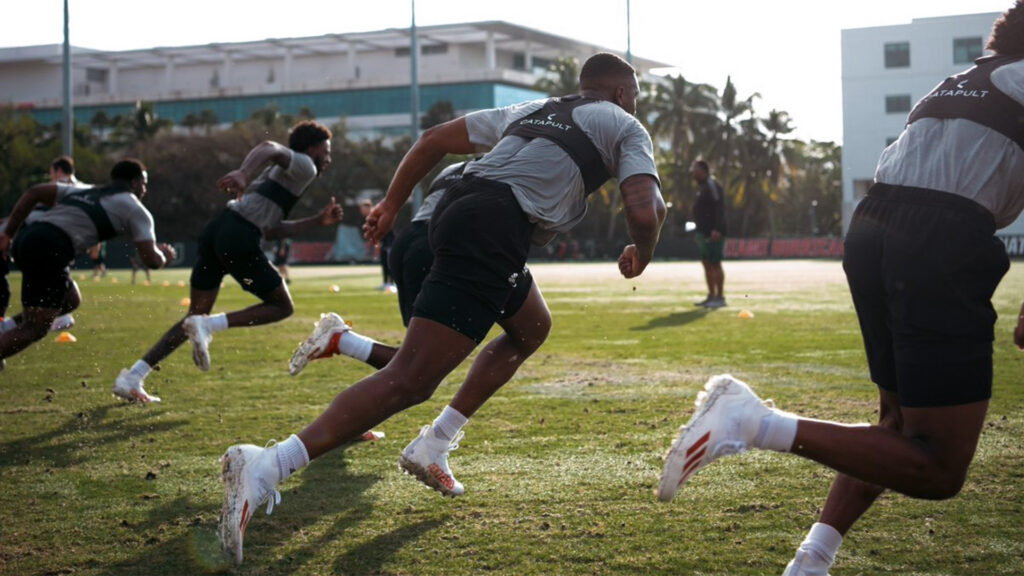
Macro-Scheduling vs. Micro-Workloads
When soft-tissue injuries strike in the opening weeks of the season, fans, media, and even coaching staffs often look for macro-level scapegoats. Long travel schedules, playing international games in Europe, or drawing an unfavorable early-season bye week are frequently blamed for physical breakdowns.
However, research tracking 1,275 injuries across five NFL seasons debunks this narrative entirely1:
- Bye week timing showed zero measurable effect on injury incidence or Injured Reserve (IR) placements.
- Travel distance and international games showed no statistical link to higher injury rates.
The Business Case: Player Availability = Postseason Success
While scheduling factors proved irrelevant, the five-season study revealed one statistically significant trend: teams that missed the playoffs suffered significantly higher injury rates and placed far more players on Injured Reserve than playoff teams.
The takeaway is: Player availability directly drives postseason success. September is where the early-season injury surge takes root, and losing key starters to preventable soft-tissue tears in Week 2 can be the exact reason a franchise sits out in January.
If macro-scheduling factors don’t cause these injuries, what does? The most critical factor lies in how performance teams handle in-season periodization and the training effect curve.
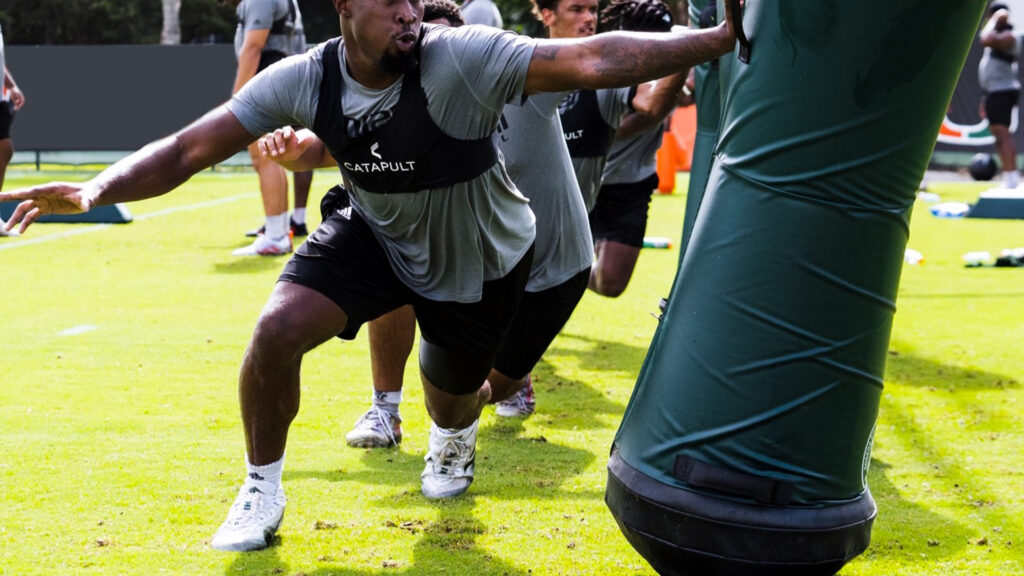
Practice IS the Answer: Periodization and the Training Effect Curve
You cannot protect an athlete from the demands of the game by hiding them in a bubble. Tissue resilience and performance capability are built through high-quality, targeted neural stimulus.
Every training session triggers a predictable biological response along the Training Effect Curve:
The Stimulus: Practice places physical and neural stress on the athlete, temporarily depressing capacity.
The Recovery: As fatigue dissipates, the body adapts.
Supercompensation: The athlete returns to a higher baseline of physical readiness.
The danger in September isn’t the presence of hard practice; it’s mismanaging the Sunday-to-Sunday microcycle. If the weekly periodization fails to provide enough neural stimulus, players are exposed to game forces they aren’t prepared to handle. Conversely, if practice pushes past the physical ceiling, the athlete remains trapped in the fatigue trough when Sunday arrives.
Acceleration: The Purest Metric in Football
While media commentary often focuses on top-end velocity, acceleration is the purest physical demand in American football.
An offensive lineman may never have the open-field runway required to reach max velocity, but every single player on the field accelerates explosively on every play. Repeated maximal acceleration efforts subject the hamstrings and adductors to high maximal force output, placing them under significant mechanical strain.
To prepare players for Sunday’s competitive benchmarks, coaches must safely expose them to high-density acceleration efforts during mid-week microcycles, setting a clear floor to build tolerance and a strict ceiling to prevent over-fatigue.
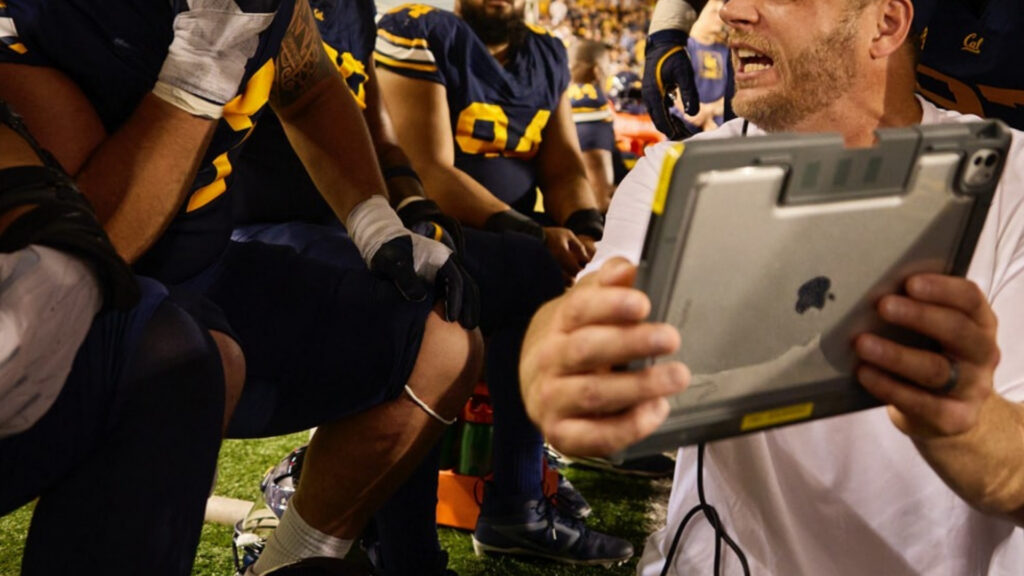
Closing the Loop: The Vector, Thunder, and Perch Ecosystem
Managing the delicate balance between neural stimulus and recovery across a 17-game season requires data integration. By linking Catapult Vector, Catapult Thunder and Perch, NFL staff benefit from a continuous feedback loop across the field, the post-match analysis and the weight room.
By using Catapult Vector wearable sensors, Catapult Thunder video analysis and Perch velocity-based training (VBT) technology, NFL teams can close this loop entirely, synchronizing on-field outputs with weight-room prescriptions.
Tracking Neural Stimulus on the Field (Vector)
Using Vector’s dual GPS/LPS units, performance specialists track the exact volume and density of explosive accelerations and high-intensity efforts during practice. Rather than relying solely on total yardage (which can mask underlying fatigue), Vector allows coaches to monitor live whether players are hitting their position-specific neural thresholds during midweek microcycles without exceeding their daily workload ceiling.
Contextualizing load (Thunder Video)
Data without context can lead to incomplete decision-making. By using Vector data for GPS and Catapult Thunder for video analysis, performance specialists don’t just see a spike in mechanical load; they can work alongside the GPS to see why it happened.
Did a cornerback’s player load spike because they covered three consecutive vertical routes, or was it a more dense indy (individual) drill? This context allows staff to determine whether the fatigue is a normal byproduct of tactical demands or an anomaly requiring intervention.
Autoregulating Recovery in the Gym (Perch VBT)
Once fatigue is flagged on the field and contextualized via film, the solution is deployed in the weight room using Perch. Instead of forcing a neurally fatigued athlete to lift a high percentage of their 1-Rep Max (which would further red-line their nervous system and increase soft-tissue risk), the strength staff utilizes VBT.
Coaches can command a specific velocity zone (e.g., maintaining a mean concentric velocity to preserve power). If the player’s nervous system is compromised from Sunday’s game, Perch’s camera sensors detect the slower bar speed in real time. The system acts as a prompt to the coach to scale the physical weight down so the athlete can still safely hit their speed threshold, maintaining power output without overloading a fatigued central nervous system.

Moving Past Guesswork
Early-season injuries are not a matter of travel or bad luck. They are a periodization and workload management challenge.
Practice is the key to building resilient athletes, provided the neural stimulus is precisely tracked and recovered from. By tracking on-field micro-movements, video context, and weight-room outputs through Catapult technology, elite performance departments ensure they don’t blow that engine up during September. They are managing the high-speed transition with precision, keeping star players healthy and available throughout the full season without any gaps in their data.
Q&A
The early-season injury surge is triggered by the abrupt transition from controlled training camps to the maximum-intensity, 60-minute reality of Week 1. Research tracking 1,275 injuries over five NFL seasons debunks the myth that macro-scheduling factors like travel or early bye weeks cause these injuries. Rather, these breakdowns are a periodization and workload management challenge tied to the Sunday-to-Sunday microcycle.
While top-end velocity is often highlighted, acceleration is the purest physical demand in football because every single player on the field accelerates explosively on every play. These repeated maximal acceleration efforts subject the hamstrings and adductors to high mechanical strain. Coaches must expose players to high-density acceleration efforts during mid-week practice to safely build their physical tolerance and prevent over-fatigue.
Performance staffs manage readiness by synchronizing on-field outputs with weight-room prescriptions to prevent overloading a fatigued central nervous system. They track neural stimulus on the field using Catapult Vector, contextualize physical spikes through Catapult Thunder video analysis, and autoregulate lifting intensity with Perch’s velocity-based training (VBT) technology.
- Angileri HS, McLoughlin DE, Owen MM, May JM, Terry MA, Tjong VK. Association of Injury Rates Among Players in the National Football League With Playoff Qualification, Travel Distance, Game Timing, and the Addition of Another Game: Data From the 2017 to 2022 Seasons. Orthop J Sports Med. 2023 Aug 2;11(8):23259671231177633. doi: 10.1177/23259671231177633. PMID: 37547079; PMCID: PMC10399261.
↩︎