England vs Mexico: Turning Altitude Into Performance Intelligence
Hannah Knowles, Catapult Sports
Key Takeaways:
- Prioritize Individual Adaptation Over Blanket Models: Altitude tolerance is complex and determined by a mix of genetic predisposition and environmental exposure. Practitioners cannot rely on assumptions based on an athlete’s sea-level club environment; instead, they must build individual performance profiles based on data gathered during training camps and fixtures at altitude.
- Differentiate Internal Strain From External Output: By integrating heart-rate monitoring with metrics like PlayerLoad™, sports scientists can evaluate mechanical work independently of cardiovascular stress. Under hypoxic conditions, a similar physical output on the pitch can mask drastically different levels of internal physiological strain between individual athletes.
- Build a Longitudinal Predictive Playbook: Every high-altitude fixture or simulated training block acts as a live testing laboratory. Capturing this environmental performance data longitudinally across multiple tournament cycles creates a predictive playbook that can guide personalized preparation, recovery interventions, and future player selections.

England’s knockout encounter with Mexico provided another reminder that altitude remains one of football’s performance challenges.
The post-match conversation inevitably returned to Mexico City’s elevation and the demands of competing at 2,200 metres above sea level at the Estadio Azteca. Reduced oxygen availability lowers aerobic capacity, accelerates fatigue, influences recovery and alters the physical profile of matches, particularly for players with limited exposure to severe hypoxic stress.
But from a performance perspective, the real lesson extends far beyond a single result.
Matches like these should not simply be viewed as environmental challenges to overcome. They represent opportunities to gather intelligence that can shape future preparation, selection and performance strategies across entire tournament cycles.
The Reality of Mexico’s Advantage
Discussions around altitude often focus exclusively on where players currently compete. Yet physiology is more complex than geography alone.
While many top tier Mexican players now perform at sea level across Europe, a significant proportion originate from the Altiplano Mexicano, the Mexican Highlands, where populations have lived at altitude for generations. Research has shown that long-term high-altitude populations can develop inherited physiological characteristics, including larger lung volumes, expanded alveolar-capillary surface areas and altered ventilatory responses to hypoxia (Frisancho, 1975; Brutsaert et al., 2002).
That does not mean every athlete responds identically, nor that ancestry alone determines performance outcomes. But it does reinforce an important principle for practitioners: individual adaptation to altitude is shaped by a combination of environmental exposure and genetic predisposition. Two top tier players competing at sea level today can arrive at a major tournament with fundamentally different physiological starting points when exposed to hypoxic stress.
For visiting teams, the challenge is therefore twofold. Acute exposure to altitude results in arterial oxygen desaturation and rapid homeostatic adjustments, while opponents with long-standing developmental or generational connections to high-altitude environments may begin from a more advantageous baseline.
This is precisely why measurement matters. Assumptions based on club environments or previous experiences at sea level rarely provide the complete picture. Individual responses to hypoxia must be understood through performance data gathered across training camps and competitive fixtures.
Simulated Altitude Training + Catapult Data = Actionable Performance Intelligence
Top tier programs increasingly prepare for altitude before they arrive, whether through dedicated camps or simulated hypoxic environments. But creating the stimulus is only half the equation.
The competitive advantage comes from measuring how athletes respond.
Using Catapult systems during hypoxic training blocks allows practitioners to establish detailed performance profiles long before major tournaments begin. By combining multi-inertial and cardiovascular telemetry, sports scientists can map an athlete’s adaptation curve under environmental stress.
Key questions emerge:
- Which players maintain their high-speed running outputs?
- Who experiences disproportionate cardiovascular strain relative to external load?
- Which athletes recover effectively between repeated high-intensity efforts?
- How do movement strategies evolve as fatigue accumulates?
Those answers create opportunities for targeted interventions before altitude becomes a competitive problem.
Internal vs External Load Discrepancies
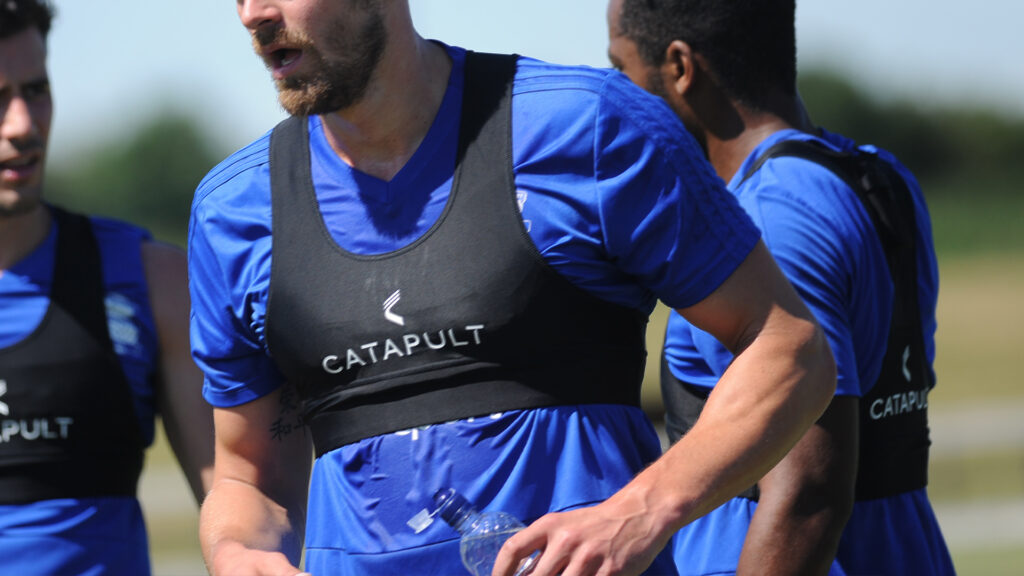
By integrating heart-rate monitoring with PlayerLoad™, Catapult’s proprietary tri-axial accelerometer metric developed alongside the Australian Institute of Sport, practitioners can evaluate mechanical work independently of distance covered.
Because match contexts and session objectives vary, comparing absolute volume outputs between environments can be misleading. The real intelligence lies in tracking an individual’s efficiency ratio, monitoring how much internal cardiovascular strain it takes to produce a standard unit of external work compared to that player’s own sea-level baseline.
Some athletes maintain normal movement outputs with only modest increases in cardiovascular strain. Others exhibit significantly elevated heart-rate responses while producing similar external PlayerLoad™, suggesting a much greater physiological cost of performance under hypoxic conditions.
High-Speed Running Decay
Repeated sprint capacity is often among the first qualities to deteriorate at altitude.
Using customisable Velocity Bands within OpenField, analysts can monitor how high-speed running outputs evolve throughout training sessions and competitive fixtures. This allows practitioners to identify players who maintain repeated high-intensity efforts, those whose outputs decline rapidly under hypoxic stress, and position-specific demands that may require alternative loading strategies.
Rather than applying a blanket acclimatisation model, teams can design interventions that reflect the unique physiological responses of each athlete.

Football Movement Profiles and Mechanical Adaptation
Altitude does not simply influence how much players run, it can also affect how they move.
Catapult Vector’s Football Movement Profile and Inertial Movement Analysis use inertial sensors to categorise football-specific explosive actions across both linear and multidirectional movement patterns.
These insights can reveal subtle changes in mechanical efficiency as physiological strain increases. Athletes may unconsciously reduce explosive decelerations or high-intensity changes of direction in favour of more economical movement strategies as oxygen availability declines and fatigue accumulates.
Understanding these adaptations provides additional context when evaluating readiness and performance capacity for future high-altitude competition.

From Match Analysis to Future Selection
The greatest value emerges when this information becomes longitudinal.
Every altitude camp and international fixture contributes to a growing database of environmental performance profiles. Over multiple competition cycles, that information becomes a powerful decision-making tool.
If two players are tactically comparable ahead of future fixtures in Mexico, historical performance under hypoxic stress may provide an additional layer of evidence:
- Which athlete consistently maintains physical outputs?
- Which requires modified preparation or recovery strategies?
- Which demonstrates greater resilience across congested tournament schedules?
Rather than applying a one-size-fits-all acclimatisation model, practitioners can design individual loading strategies that reflect how each athlete responds to environmental stress, maximising the likelihood that the entire group peaks together when it matters most.
Turning Environmental Challenges Into Competitive Intelligence
England’s knockout match against Mexico reinforced something performance practitioners have understood for years: altitude matters.
But it also highlighted a broader opportunity.
Every high-altitude fixture provides a live testing laboratory. Every exposure to hypoxic conditions generates information that can improve future preparation, athlete management, and decision-making.
By capturing this data longitudinally, sports scientists are not simply managing the current 90 minutes, they are building a predictive playbook for the next international cycle.
Altitude only remains a disadvantage if it goes unmeasured.
With the right combination of monitoring and longitudinal Catapult data, today’s environmental challenge becomes tomorrow’s competitive intelligence.
References
- Brutsaert TD. Genetic and environmental adaptation in high altitude natives. Conceptual, methodological, and statistical concerns. Adv Exp Med Biol. 2001;502:133-51. doi: 10.1007/978-1-4757-3401-0_10. PMID: 11950135.
- Frisancho AR. Functional adaptation to high altitude hypoxia. Science. 1975 Jan 31;187(4174):313-9. doi: 10.1126/science.1089311. PMID: 1089311.
Q&A
Physiology under altitude stress is more complex than a player’s current club geography. Long-term high-altitude populations, such as those originating from the Mexican Highlands (Altiplano Mexicano), can develop inherited physiological characteristics over generations. Research indicates these traits include larger lung volumes, expanded alveolar-capillary surface areas, and altered ventilatory responses to hypoxia, allowing them to begin from a more advantageous baseline than visiting players.
Altitude affects both how much players run and how efficiently they move. Using customizable Velocity Bands within OpenField allows analysts to monitor the decay of high-speed running outputs over the course of a fixture. Additionally, Catapult Vector’s Football Movement Profile utilizes inertial sensors to track explosive linear and multidirectional actions, revealing subtle adaptations where a player might unconsciously reduce explosive decelerations or high-intensity changes of direction to conserve energy as oxygen availability declines.
Utilizing tracking systems during simulated hypoxic training blocks allows sports scientists to map an athlete’s unique adaptation curve long before a tournament cycle begins. This data helps answer critical preparation questions, such as identifying which players maintain high-speed outputs, who experiences disproportionate cardiovascular strain relative to their external load, and who recovers effectively between repeated high-intensity efforts. This data gives practitioners a chance to design targeted, individualized preparation and recovery strategies before altitude becomes a competitive problem.